
10 Craziest Anime Plot Twists Of All Time
Across diverse media art forms, nothing surpasses the jarring impact of well-constructed plot twists no one saw coming. These twists elevate the quality of stories, leaving lasting impacts on the minds of viewers or readers. As expected, anime has more than a fair share of mind-bending story pivots that fans of the medium will never forget.
These twists make viewers question motives, morality and memory, evoking feelings that oscillates between awe and shock. In these moments, the author’s mastery over the story is revealed, as they manage to pull the rug from under the audience’s feet while keeping every detail believable.
It is based on these remarkable traits that these anime are remembered not just for their strong writing, but for the precision of their narrative reversals. These anime feature narrative twists that linger long after the credits roll underpinning an immutable storytelling truth: a thriller is only as good as its surprises.
Blast Of Tempest
Directed by Masahiro Andō, Blast of Tempest finely balances Shakespearean lore with mystery and philosophy in a tale that begins as a revenge story but transforms into a study of human logic and fate. The story’s central twist violently overturns its narrative map, revealing that what seemed like divine intervention was actually the result of calculated human logic.
However, the revelation isn’t just shocking, it effectively reframes the story’s foundation from moral extremism into a commentary on human will and its consequences. As a result, each of the characters’ motivations gain new weight, and the show’s earlier scenes take on new meaning.
Instead of relying on performance, the twist deepens the philosophical tension that defines the show, taking the narrative from a fantasy to a reflection on how people confront fate and destiny. Ultimately, Blast of Tempest’s manipulation of its own narrative make it a story that etches itself in the audience’s memory.
Death Note
Studio MadHouse’s Death Note set the gold standard for psychological twists as quickly as it made its debut. The battle between the characters, Light and L builds through intellect and ego until the series’ midpoint twist upends everything that comes before.
What follows after that point is a stark shift in perspective that forces both Light and the audience to face the cost of absolute power. The change is nonetheless daring but also purposeful because the story never abandons logic, it evolves it. With every new revelation, the story is pushed deeper into its own questions of justice and obsession.
Rather than cheap shock, the twist shifts the narrative from the boundaries of power to an examination of human frailty. In all, Death Note shows that true unpredictability doesn’t come from randomness, but from the clarity of logic and the show details precisely the kind of writing that makes every surprise feel both inevitable and haunting.
Moriarty the Patriot
Moriarty the Patriot reimagines the familiar legend of Sherlock Holmes through a moral lens. Rather than portraying Moriarty as a simple villain right from the jump, the series slowly reveals him as an antihero with a cause rooted in justice.
Still, the story’s defining twist does not come in a single moment but in the gradual understanding that Moriarty’s revolution has ethical weight. By presenting Sherlock Holmes as an ideological equal rather than his enemy, the series quietly transforms its supposed rivalry into a debate about social order.
However, what makes the change so brilliant is how naturally it unfolds through gradual conviction, and not instant deceit. The twist challenges the audience to question who deserves sympathy in a broken system, proving that justice and villainy will nearly be indistinguishable under a corrupt system.
Erased
Erased tells a tale that starts as a mystery thriller but quietly becomes a reflection on regret and redemption. The story revolves around the 29-year-old Satoru Fujinuma, who has an ability that lets his consciousness go back in time.
From the moment when he is initially thrown back in time to prevent tragedy, the series constructs a psychological puzzle that intensely strikes the viewer personally. When the story’s real culprit is revealed, the twist lands with emotional precision. For Fujinuma, it’s not just about solving the possible deaths, it’s about confronting his own helplessness.
The twist hits harder because the intention behind it not to surprise but to cause heart ache. Ultimately, Erased earns its reputation through empathy because it crafts a story where every small clue feels like an emotional breadcrumb leading to a devastating truth.
Classroom of the Elite
Classroom of the Elite disguises a psychological experiment as a school drama. Its most powerful twist is the reveal that the protagonist, Ayanokōji, hides intelligence and ambition beneath his rather convincing emotionless façade. This singular moment shifts the show’s tone from one of social satire to that of a psychological chess match.
The story that once seemed like youthful competition turns out to be an experiment in social engineering. Fortunately, the story thrives on this narrative shift that turns school dynamics into a test of logic and survival.
Rather feel forced, the twist is earned through detailed character interaction and patient narrative build up. In the end, Classroom of the Elite thrives on its balance of control and unpredictability and is proof that intellectual deceit can be more shocking than any act of violence.
Monster
Masayuki Kojima’s Monster replaces the usual flashy plot twists with a slow, horrifying revelation, which is that saving one life can destroy countless others. When Dr. Tenma learns the true cost of his compassion, the story turns from moral certainty to haunting ambiguity.
The show’s twist is built entirely on one inevitability, with each clue quietly tightening around the same truth. That evil as far as the story is concerned isn’t supernatural but entirely logical and human. In the same vein, its precise realism makes the revelation unbearable.
Instead of breaking the story’s flow, the twist redefines it, turning a doctor’s act of kindness into the origin point of unmasked terror. Unlike other anime, Monster stands out because it unfolds the story painstakingly.
No Game No Life
Adapted from the light novel series witten by Yuu Kumiya, No Game No Life thrives on the balance of impossible challenges resolved through improbable logic. Widely known for its wild color and vast imagination, the story’s most surprising plot turn isn’t about betrayal or hidden motives but how it reveals the structure behind its chaos.
Every game feels impossible until the siblings’ reasoning exposes its hidden fairness, and when the truth surfaces, what once looked like ridiculous luck becomes pure calculation. Interestingly, the twist works because it celebrates intelligence, not deceit because each reveal rewires the audience’s understanding of the game’s rules and the characters’ brilliance.
Consequently, the series is proof that cleverness can be as shocking as betrayal. It is one of the rare shows that consistently turns disbelief into admiration.
Code Geass
Code Geass builds its story around power and control, culminating in one of anime’s most perfectly executed plot twists. Lelouch’s final act reframes the entire series, turning a rebellion into a sacrifice that brings peace, effectively rewriting the meaning of heroism.
Every previous plan, preconceived lie, and alliance finds its conclusion in that moment. The twist is strikingly memorable not because it’s unpredictable, but because of its inevitability once revealed.
Connecting every theme into a single decision, the brilliance lies in its precision: an ending that is both tragic and complete. The twist defines the series, transforming a tale of conquest into a meditation on peace, power, and purpose, bringing about one of anime’s most haunting conclusions.
Attack on Titan
The creation of Hajime Isayama, Attack on Titan tells a tale built on deception. Right off the bat, its first episode already showed glimpses of its mystery. However, what it delivered was a world constructed on layers of lies.
What begins as survival horror evolves into a political tragedy through a sequence of thorough reveals. Each narrative twist expands the world, showing how myths disguise history. Yet, the show’s defining moment manages to reposition everything: enemies become victims, heroes turn into perpetrators, and moral certainty collapses.
The transition feels brutal yet methodical, as every clue to its revelation is hidden in plain sight. Therefore, when the truth arrives, it changes not just the plot but the viewer’s perspective. Most importantly, Attack on Titan demonstrates how worldbuilding can serve as narrative misdirection, using mystery to explore its other themes.
The Promised Neverland
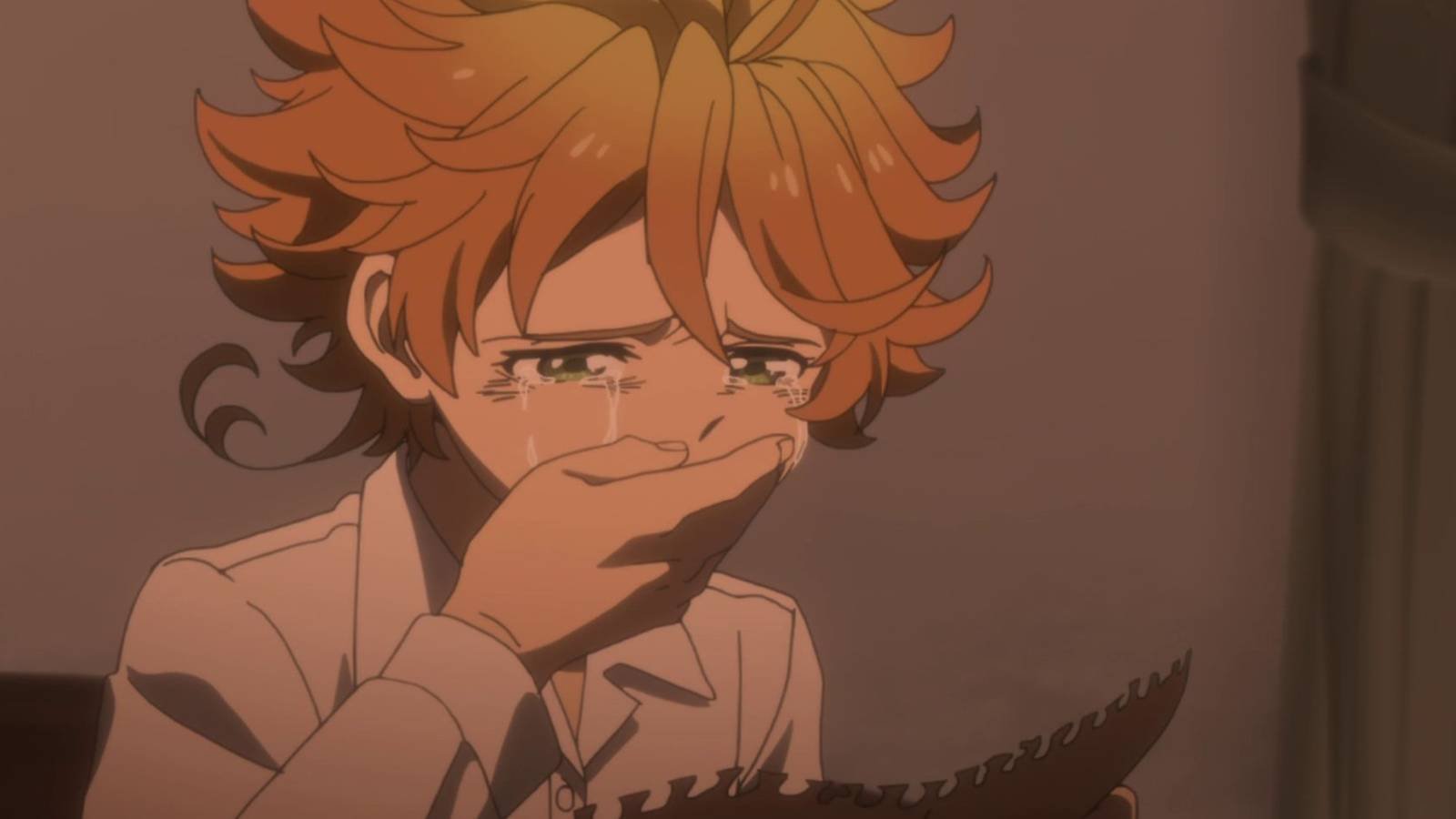
It will be quite accurate to say that The Promised Neverland crafts one of anime’s most striking opening twists. What appears to be an idyllic orphanage at first glance is exposed as a system of cruelty involving children who are raised as livestock.
The reveal transforms the story from a gentle mystery into a tense escape horror thriller. Notwithstanding, the strength of twist lies in its calculated restraint, as the clues are visible from the start, but well disguised through the story’s tone.
It redefines the children’s innocence, and instead of using violence, the series sustains its sense of dread through the characters’ intellect and cooperation. However, the story’s horror is psychological, not physical, such that even after the truth of the orphanage is known, its weight shapes every decision that follows.