Hunter x Hunter Nen Explained: Every Category
Here is Hunter x Hunter Nen explained in one sentence: it is the life energy every person gives off, called aura, and a trained user can control it under rules that never bend. That last part is why so many fans call Nen the best power system in shonen. This guide covers the basics, the categories, the hexagon and the vows that decide the biggest fights. Spoilers stay light until the conditions section, which touches the Chimera Ant arc.
What is Nen in Hunter x Hunter?
Everyone leaks aura from their body all the time. Most people never notice, and it simply drains away. A Nen user opens their aura nodes and learns to hold that energy, shape it and use it. There are two ways to open the nodes. The slow, safe way is meditation and training, the path Zushi is following when Gon and Killua meet him in Heavens Arena. The fast, dangerous way is having another user force the nodes open by blasting you with aura, which is what Wing does for Gon and Killua because they need Nen quickly to survive the fighters on the upper floors.
Nen is also the hidden final step of becoming a Hunter. Passing the exam is not enough; members are expected to learn Nen too.
Hunter x Hunter Nen explained: the four principles
Every Nen user learns the same four basics, in order. Wing’s lessons in Heavens Arena are the series’ tutorial.
- Ten. Keeping your aura wrapped around the body instead of letting it leak. It works as a shield and slows aging, and it is the base of everything else.
- Zetsu. Shutting off your aura completely. It hides your presence and speeds recovery from fatigue, but it leaves you defenseless against an attack charged with Nen.
- Ren. Pushing out more aura than normal. This is the power boost used for attack and intimidation.
- Hatsu. The personal application of Nen, your own unique ability. This is where the categories come in.
Advanced Nen techniques
Once the basics are solid, users combine them into advanced techniques. These show up constantly in fights, so they are worth knowing.
- Gyo concentrates aura in one part of the body, usually the eyes, to see hidden aura.
- In is an advanced Zetsu that hides your aura, or an ability, from other users. Gyo is the counter to it.
- En extends your aura in a circle around you so you can sense everything inside it. Neferpitou’s huge, uneven En is one of the scariest images in the Chimera Ant arc.
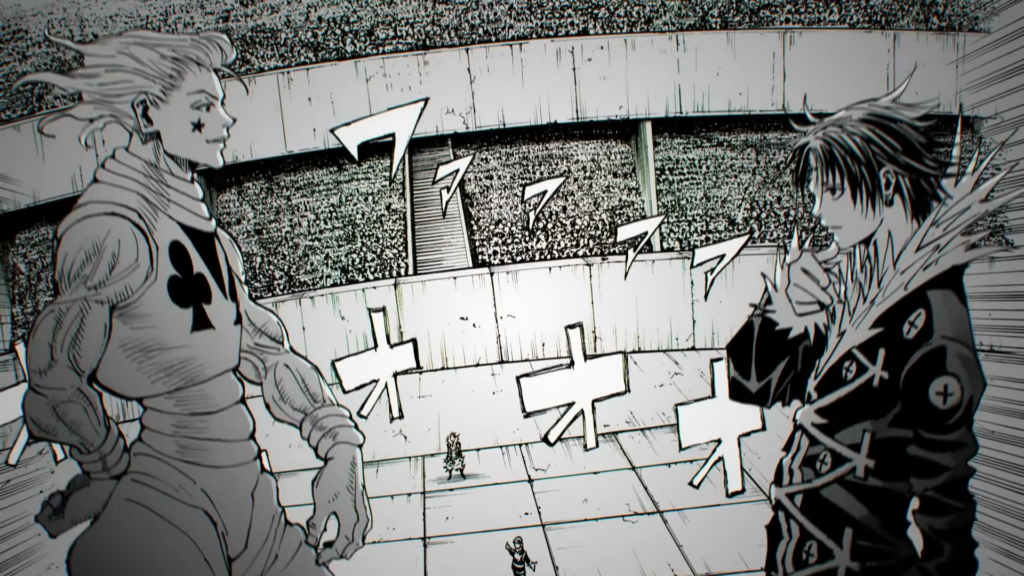
- Shu wraps aura around an object, which is how Hisoka turns playing cards into blades.
- Ko pours all your aura into one body part for a massive hit, leaving the rest of you exposed. Gon’s Jajanken Rock is built on it.
- Ken holds Ren across the whole body for defense, and Ryu is shifting aura between attack and defense in real time, which Gon and Killua train hard on Greed Island under Biscuit.
The six Nen categories explained
Every user is born with an affinity for one category. The water divination test reveals it: you put a leaf on a glass of water, hold your hands around the glass and use Ren. What happens to the water tells you your type.
| Category | Water divination result | Known users |
|---|---|---|
| Enhancer | The amount of water increases | Gon, Uvogin, Netero |
| Transmuter | The taste of the water changes | Killua, Hisoka, Biscuit |
| Emitter | The color of the water changes | Leorio, Razor, Franklin |
| Conjurer | Impurities appear in the water | Kurapika, Kite |
| Manipulator | The leaf moves | Illumi, Shalnark, Morel |
| Specialist | Some other change happens | Chrollo, Neon Nostrade |
Enhancers strengthen their bodies and simple objects. It sounds basic, but it makes them the most balanced fighters, and both Gon and Chairman Netero belong here. Transmuters change the properties of aura, like Killua turning his into electricity or Hisoka making his stretch and stick like gum. Emitters send aura away from the body and keep it working at a distance. Conjurers create physical objects out of aura, like Kurapika’s chains, and usually attach strict rules to them. Manipulators control living things or objects, often through a trigger like Illumi’s needles. Specialists have abilities that fit nowhere else, like Chrollo’s Skill Hunter, which steals other people’s abilities.
The Nen hexagon and why it matters
The six categories sit on a hexagon. Enhancement is at the top, Transmutation and Emission sit on either side of it, Conjuration and Manipulation sit below those, and Specialization sits at the bottom, opposite Enhancement. A user can learn any category except Specialization, but how well they can use it depends on distance. Your own category is 100 percent efficient, the neighbors are 80 percent, two steps away is 60 percent, and the opposite side is 40 percent.
That is why Gon’s Jajanken works so cleanly. Rock is Enhancement, his natural type. Paper is Emission and Scissors is Transmutation, the two categories right next to his. Togashi built the hero’s signature move straight out of the chart.
Conditions and vows: how Nen limits create power
This is the rule that makes Nen brilliant. A user can make an ability far stronger by accepting a restriction, and the bigger the risk, the bigger the payoff. Kurapika’s Chain Jail can hold even the strongest members of the Phantom Troupe because he swore to die if he ever used it on anyone outside the Troupe. Later, the Succession War arc reveals the cost of his Emperor Time, which turns him into a Specialist: every second it stays active takes an hour off his life.
Gon’s transformation against Neferpitou is the extreme case. He forces his body to the age and strength needed to win, paying with every bit of potential he had left. Nen can also outlive its user. A strong enough grudge can make an ability grow even more dangerous after death, which is why the series treats dead users as a real threat.
Hunter x Hunter Nen explained: why the system works
Nen never lets anyone win by simply wanting it more. Every victory in Hunter x Hunter is a puzzle solved: reading the opponent’s category, guessing their conditions, and finding the gap. Information becomes as valuable as strength, and a weak character with a clever rule can beat a monster. That is why the fights feel like chess.
Where to watch Hunter x Hunter
The 2011 Madhouse adaptation, 148 episodes long, is the version most people start with, and it covers Nen in full detail from the Heavens Arena arc onward. Services like Crunchyroll, Netflix and Hulu have carried the 2011 series at different times, but availability varies by region and changes often, so check a tracker like JustWatch for your country. The manga by Yoshihiro Togashi runs in Weekly Shonen Jump and is famous for long breaks between batches of chapters.
FAQ
What are the six Nen types?
Enhancer, Transmuter, Emitter, Conjurer, Manipulator and Specialist. Your type is fixed at birth and revealed by water divination.
What is Gon’s Nen type?
Gon is an Enhancer. His best friend Killua is a Transmuter.
What is the rarest Nen type?
Specialist. It covers abilities that fit no other category, and other users cannot learn it the way they can learn the rest.
My take: Nen is the system every other shonen borrows from, and none of them match it, because Togashi made the limits the point instead of the obstacle. In most battle series the hero wins because he trains harder or screams louder. In Hunter x Hunter, Kurapika wins because he signed a contract with his own life, and Gon wins because he throws his future away. Those victories cost something you can measure, and that is why they land. The hexagon matters too. It gives readers enough information to predict fights, which makes the surprises fair. My prediction: when the Succession War is finally animated, it will be remembered less for any single big fight and more for its contracts, its rules and its information games, the purest form of Nen we have seen. That is also why it will be hard to adapt, and why fans will argue about how well it was done. A system built on rules rewards patient viewers, and I think it is the best argument shonen has for slowing down and thinking.